
Becoming Self-Evolving
A Journey Towards Self-Evolution

Introduction
As machines learn to improve their own improving, the human version stops being optional. Here’s what it actually involves - and a free session to watch it happen.
There’s a lot of noise about artificial intelligence right now, and most of it misses the part that actually concerns us. Here is the part that does.
The machines are learning to evolve themselves
AI crosses from clever to genuinely super-intelligent through one move: recursive self-improvement. Each generation doesn’t just solve new problems - it upgrades the system that solves problems. The improving gets better at improving.
Most of us, meanwhile, are meeting an exponential world with roughly the same inner operating system we had twenty years ago. Job skills expire in years, not decades; attention is re-engineered monthly; the shape of work and meaning keeps shifting under our feet. And we bring linear tools to it - one more course, one more fix, one problem at a time.
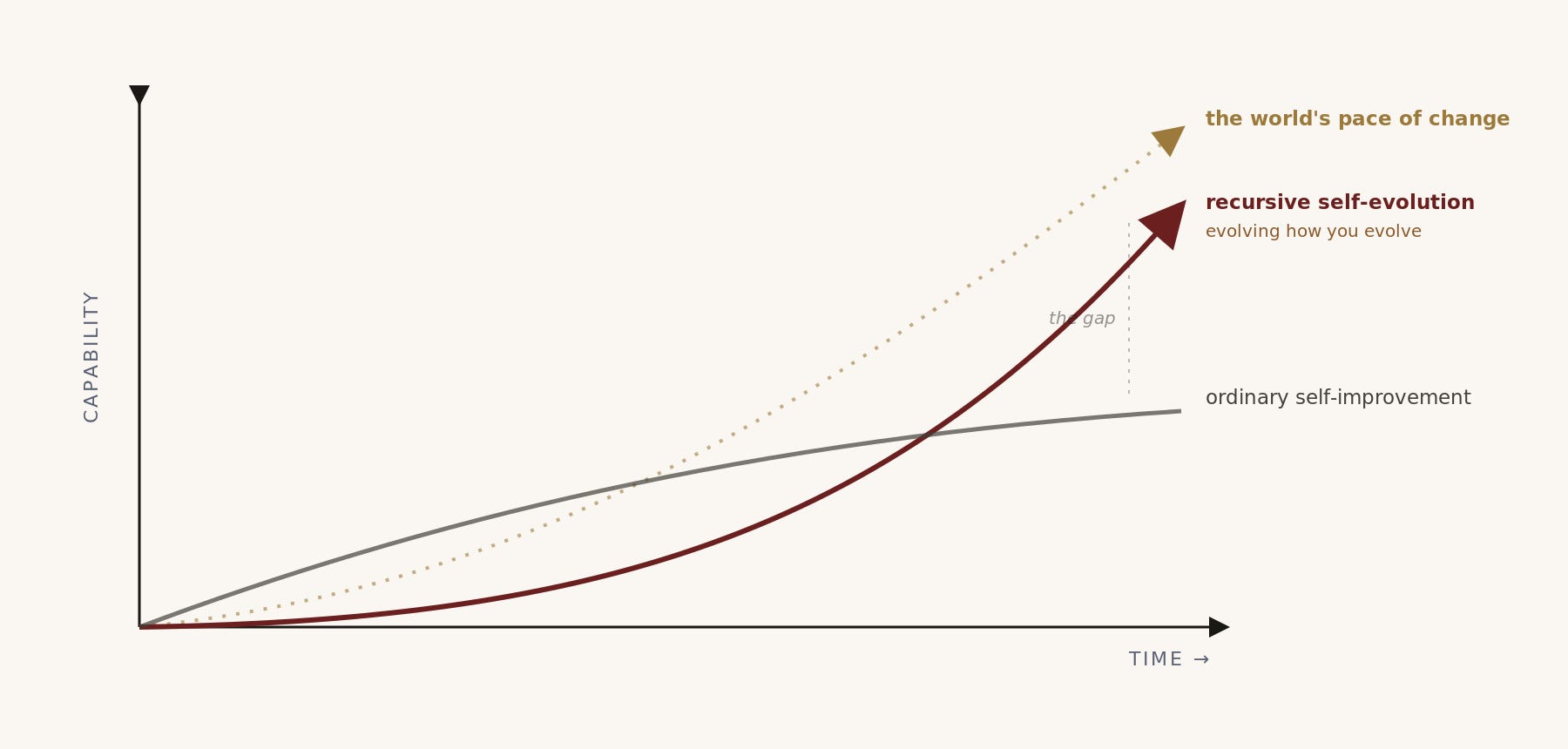
Linear vs. Recursive Growth
Ordinary development plateaus. Recursive self-evolution compounds - and keeps pace with a world that won’t stop accelerating.
The interesting question isn’t whether the machines will keep evolving. They will. It’s whether we will. As routine thinking gets automated, the human edge narrows to what doesn’t automate - consciousness, creativity, judgement, and the capacity to keep becoming someone new. That capacity is not fixed. It can be trained. And, like the machines, it can be made recursive.
Evolving how you evolve
Almost all personal development is designed to optimise who you already are: identify a problem, find a method, work the method, move on to the next problem. It works, but it scales linearly. Each problem needs its own effort, and the capacity to handle problems never really grows.
There’s a different kind of work - one level up. Instead of getting better at a thing, you get better at getting better. Your ability to change becomes capable of changing itself, and development starts to compound rather than crawl.
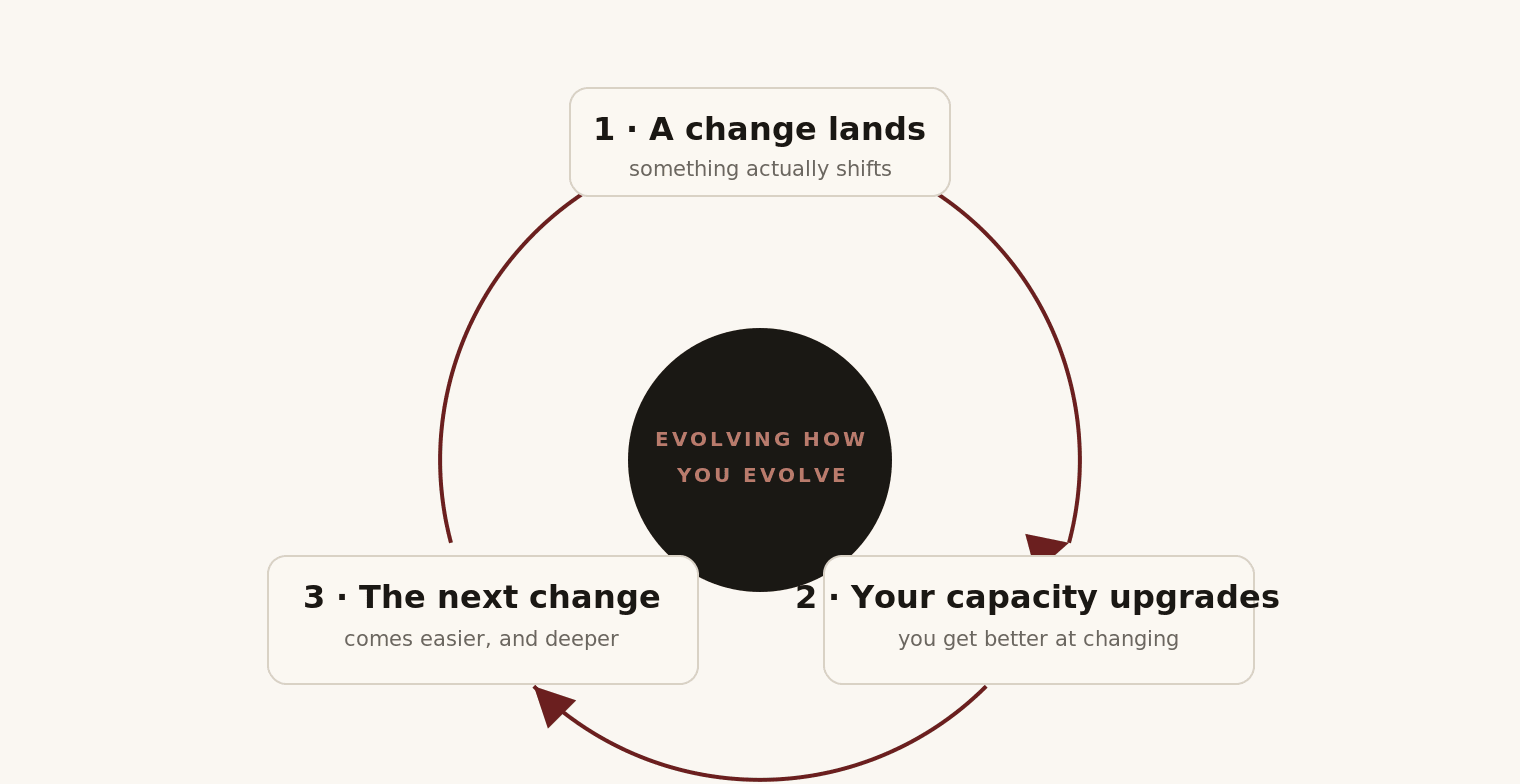
Recursive Loop Engine
Ordinary work changes you once. This changes your capacity to change - so each pass strengthens the next.
This is the whole aim of the work I’ll describe below. Not another fix - the move from having insights to being a self-evolving human being.
Why the things you push on never move
Here’s the mechanical heart of it, and it’s the part most change work gets backwards.
The belief that’s keeping you stuck is rarely the one you’d name. Underneath it sits a quieter belief about that belief - usually some version of “and to change this, I’d have to force it.” And underneath that sits a belief about change itself: “a shift like this shouldn’t even be possible.” Those lower beliefs are the ones doing the holding.
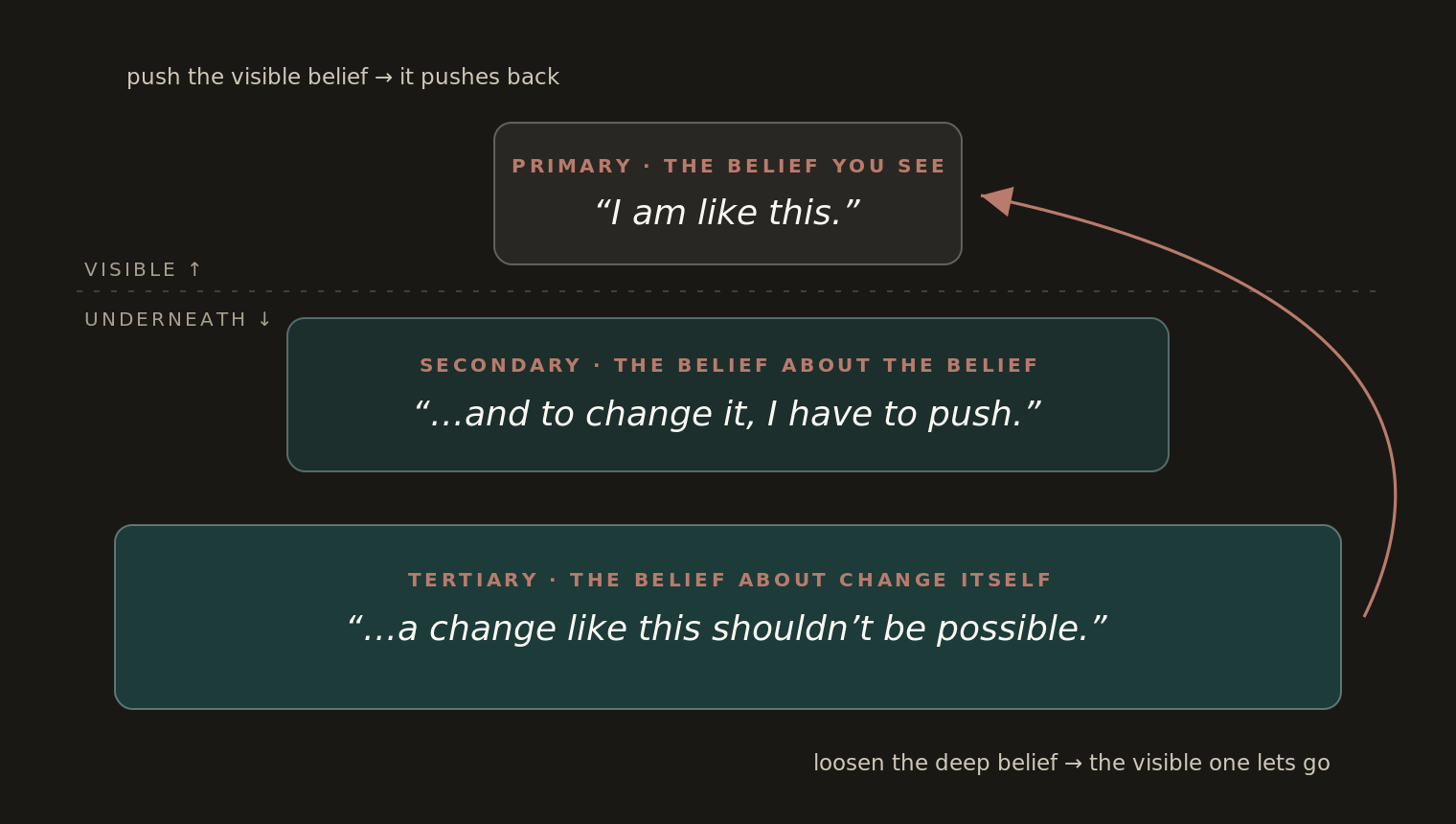
Belief Behind The Belief
The belief you can see sits on top of two you can’t. Work the visible one and you fight the whole stack; loosen the one underneath, and the visible one lets go.
So we don’t argue with the belief you can see. We don’t argue with the part of you that wants to stay at all - because opposition strengthens a structure rather than changing it. (Watch any heated argument: the harder one side pushes, the more entrenched the other gets, and both leave more certain.) Instead, we loosen the belief behind the belief, and the thing that wouldn’t move quietly does.
Non-opposition, working the second-order, relating to yourself as a process rather than a fixed thing, resetting your state before you touch the problem - these aren’t separate techniques. They’re all faces of one move: change the structure that generates your experience, by working with it rather than against it.
It applies to the whole of you
Because it’s one move rather than a set of topics, it isn’t a course about a single corner of life. The same thing runs everywhere — early development and the patterns we inherit, knowing your own energy and telling what’s you from what isn’t, relationships, the nervous system, identity, waking up to who you actually are, and turning all of it into action in the world. You bring whatever is real for you; that becomes the material.
What it tends to produce
When you work the structure instead of the content, change tends to come faster — and hold longer - than people expect. A few examples, details anonymised:
A reaction that had been firing three or four times a week simply stopped, for three months straight, after a single sitting - the person hadn’t even noticed until they were asked. Someone who genuinely couldn’t picture more than three months ahead found a living sense of three years open up in one conversation. A belief that “change has to be hard” dissolved in about twenty minutes, and made change easier across every area that came after it. A lifelong fear of water, never worked on directly, was simply gone.
None of these is a lucky exception. It’s what the approach tends to do.
Where this came from
This didn’t appear from nowhere. It’s the synthesis of two programmes that came directly before it. One - Recursive Self-Evolution - asked how a person becomes continuously self-evolving: not one change after another, but changing how you change. The next - Finding Your Flow - found that it happens through non-opposition rather than force: meeting yourself and reality as process rather than as a fixed thing. DM Life Evolution folds both into one six-month practice.
See it live — this Monday
Before the programme begins, there’s one more free live session: Monday 22 June, 1pm ET / 6pm UK. It’s part working session, part invitation - I’ll be doing real demonstrations, and you’ll get something from it whether or not you ever join. Bring something you’d like to shift.
Register for Monday’s session →
The programme
DM Life Evolution begins 29 June and runs six months, to late December - dense live sessions interleaved with self-study weeks, in a small cohort capped at twelve. It’s six months because lasting, structural change needs sustained contact; if it sounds like it could be a fit, the next step is a short call - email me at anand@adventuresinmind.co.uk
Anand Rao